Home setup of two Internet providers with automatic failover

As more of our lives depend on Internet access, it has become increasingly important that the Internet be up all the time. Most providers are pretty solid these days but no provider is perfect. My primary provider has few outages but I’ve had at least two multi-hour outages and occasional 5-minute glitches. I work mostly from home coaching busy executives over Zoom and don’t want to waste their valuable time with technical glitches if I can help it — if you have 5 minutes of downtime and it’s the wrong 5 minutes, it can be super-distracting. And from a family perspective, if the Internet goes down at home, everyone immediately yells out for me to fix it. I decided to solve the problem by getting a 2nd inexpensive Internet provider and it has been awesome. Here’s how I set that up.

When it comes to tech gear, I’m a little like the guy who constantly tweaks a hot rod in his garage even though in reality he really only needs to drive to the grocery store. In that spirit, my home router is an enterprise-grade Unifi Dream Machine Pro. For an enterprise router, it’s not that expensive — $379. (I setup a VPN on it a while back because I *could*, not because I had any use case. . . but then I found myself outside of the US trying to watch an NBA playoff game and VPN’ed into my home network to get around the geo restrictions that were blocking me from watching the game. If you’re tried to use commercial VPN services, you’ve probably seen that they’re increasingly unable to evade the major streaming providers so this was a big win. If you build it, they will come. . . )

The Unifi Dream Machine Pro (UDM Pro) has two WAN ports. For the less technical, WAN means “wide area network” but just think of it as a connection to the Internet. Consumer-grade routers usually have just one WAN port for the provider you are using but since the UDM Pro has two, you can connect two providers to it. The device OS for the UDM Pro has a WAN Failover capability meaning that if your primary Internet provider goes down, it detects the outage immediately and flips to the backup. When the primary comes back, it automatically flips back.

Having two Internet providers for very occasional outages sounds expensive, and it could be — but I noticed recently that Verizon started offering a $25/month 5G wireless router for existing Verizon Wireless customers. Given the nature of my business and all the things in my household that depend on the Internet, $25/month seems well worth it to have rock-solid Internet. (Sure, you could tether off of your phone when your Internet goes down, but setting up other family members at a moment’s notice is a pain. And what if you — the full-time home network administrator — are not home?) With the UDM Pro and WAN Failover, your existing wireless network can theoretically just keep working. I like the idea of the backup to my cable Internet being wireless since presumably if there was an incident like a cable cut in the street, my failover would be less likely to be affected (though I haven’t tested that assumption).

So how did this work in practice? I got the Verizon 5G router to use as my backup Internet. It was easy to set up. Like any wireless device, it needs to have good reception so I set it up near a window and plugged it into the backup WAN port on my UDM Pro. The video at the bottom of this post goes through the rest of the setup details. It’s also easy if you have basic network knowledge.

My primary cable connection tends to get about 300 mbps down and 50 mbps up when I’m using my laptop around the house and the secondary (the 5G) gets about 30 mbps down and 10-15 mbps up so the service. To test out if this would work for my family’s typical usage, I unplugged my primary Internet for 48 hours and didn’t tell anyone in my family that I did it. I randomly asked my wife and son if they had noticed any Internet issues and they just gave me puzzled looks. To further test, I re-enabled the primary Internet and then randomly unplugged it when I knew everyone was using their devices. I got notifications on my admin apps that the Internet had failed over to the backup. No cries for help! Everything just kept humming along.

Now I unplug the primary Internet occasionally just to enjoy the fruits of my labor. Once I even had people over to watch a big football game and the Internet went out during the game, which we were watching on a streaming service. No one noticed except me since I got the failover alert on the admin app.

So, in the final analysis, setting things up this way was a Very Good Thing. If you can spring for the UDM Pro ($379) and 5G service ($25-$35) in addition to your primary Internet, you can set this all up for yourself in less than an hour.
RIP Billy Packer

This morning, I got numerous texts from friends noting that Billy Packer had died. As one friend shared, “If you’re our age, it’s like the Big Bang – Billy Packer and college hoops were always there, before time.” And that is true. He called every Final Four in my life that I can remember. Billy Packer was a legend in North Carolina where I grew up, having played for Wake Forest before becoming a ubiquitous college basketball color commentator. Love him or hate him (and some people did!) Packer was a key part of the landscape.

I grew up in an NC State household. My dad went to NC State and was followed by my brother. I wasn’t that interested in college basketball until I was 11 and the 1983 NC State “Cardiac Pack” pulled off one of the greatest runs and championship upsets in all of sports history. Even now, watching that final shot and Lorenzo Charles’ thoroughly improbable last-second dunk gives me chills and fills me with emotion (even today, I probably watch it at least three times a year). That’s when I became addicted to college hoops and the sweeping narratives that grip the country every year during March Madness. And, of course, Billy Packer called that game.

In a certain sense, I realize that sports are trivial, but experiencing that championship with my dad was one of the highest points of our time together on this earth and I can’t think of those moments without hearing Billy Packer’s voice (“THEY WON IT!”) RIP Billy Packer.

Nobuyuki Tsujii and experiencing new music

I love music. Growing up in North Carolina, I had a steady diet of top 40 radio with a heavy dose of country music from my mother (especially Loretta Lynn, George Jones, and Tammy Wynette). While I listen to a wide variety of music, I still feel like I’ve barely scratched the surface on genres like classical, or more generally, music from outside the United States. I’ve been trying to actively change that.

Over the past few years, I’ve been making a special effort to buy tickets to performances by artists I don’t already know and in genres explicitly outside what I know. NYC has so many amazing venues with decades of proven curatorial excellence so it’s easy to do here. This approach has led me to see artists like Senegalese superstar Youssou N’Dour and Brazilian legend Caetano Veloso (check out this New Yorker piece on him: “How Caetano Veloso Revolutionized Brazil’s Sound and Spirit.”) I walked into those shows knowing nothing about the artists or their music, or even the language they were singing in. Without fail, I leave those shows a huge fan and the music becomes part of my musical identity. (If you get a chance to see either Youssou N’Dour or Caetano Veloso – DO IT. Wow. A couple of the best shows I’ve ever seen.)

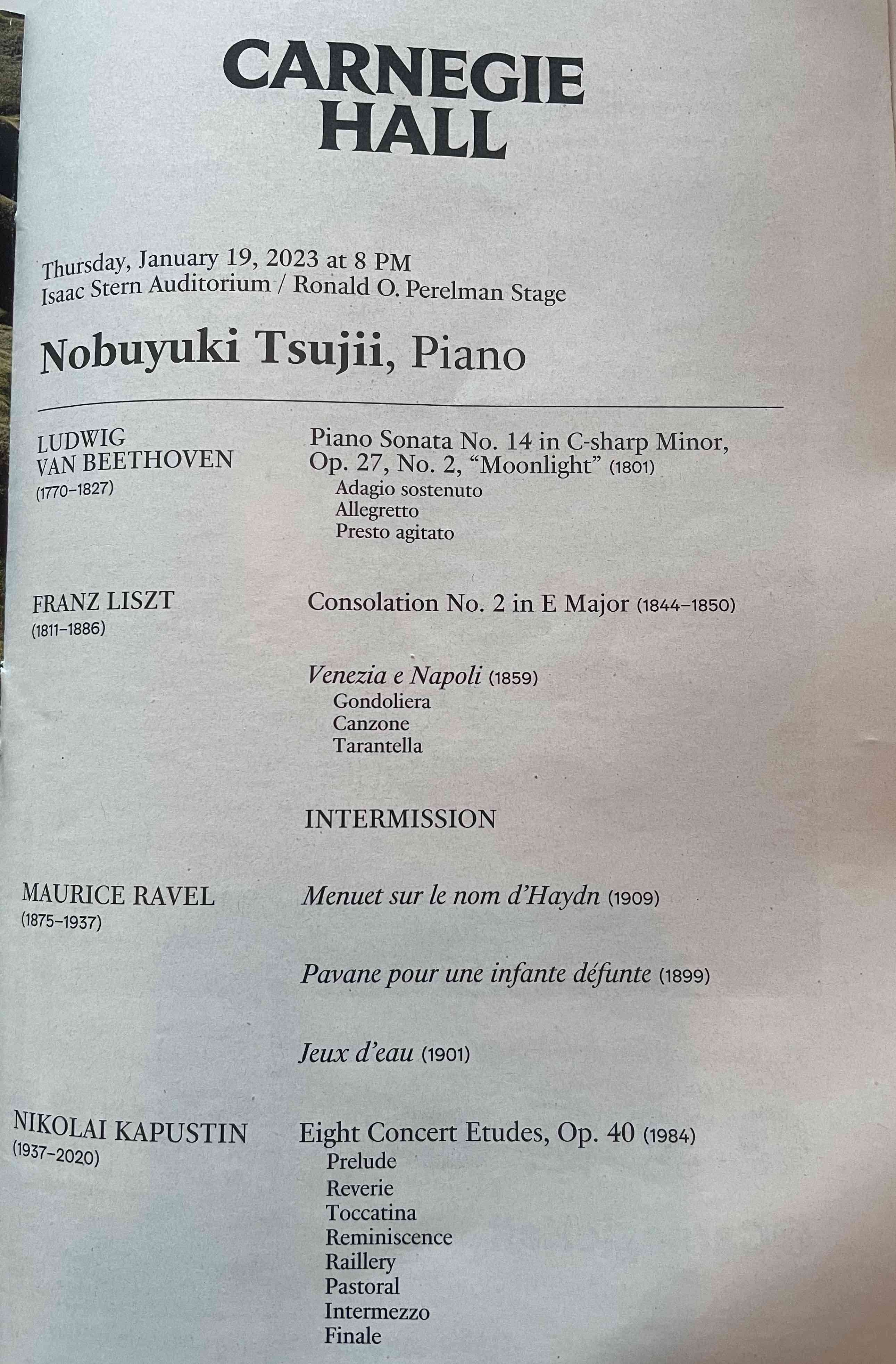
We went to one of those don’t-know-anything-about-this-artist shows last night at Carnegie Hall. The performer was Nobuyuki Tsujii, a Japanese pianist. Before these shows, I make a special effort NOT to read about the performer or listen to the music since I want to experience it fully with no pre-conceptions or pre-defined expectations. When we walked up to Carnegie Hall, the body of people in line was electric. After the crowd filed in and he came out to perform, the crowd went crazy. For the next two hours, we were blown away (see program below). We found ourselves yelling for an encore as part of a rapturous standing ovation (and we got three encores interspersed with the curtain calls).

I’m so glad we went — we’re now Nobuyuki Tsujii’s newest fans. Be sure to go see him (and other artists you might not know) when you get the chance.

11 paradoxes of leadership (from LEGO)

One of my CEO coaching clients with 30+ years of experience (much as a CEO) recently read The LEGO Story: How a Little Toy Sparked the World’s Imagination and shared the list below of 11 “paradoxes of leadership” mentioned in the book that supposedly hangs on the wall of every LEGO leader.

We both marveled at the list — neither of us had ever seen it before despite consuming voluminous content about leadership in our careers. It really captures what is needed to be a leader in all of its contradictions.

11 Paradoxes of Leadership

1. To be able to establish close relationship with your employees – and to keep proper distance
2. To take the lead – and to recede into the background
3. To show the employee confidence – and to be aware of their doings
4. To be tolerant – and to know how you want things done
5. To be concerned about your own field of responsibility – and at the same time to be loyal to the overall goals of the company
6. To plan your working-day carefully – and to be flexible to your planning
7. To express your opinion – and to be diplomatic
8. To be visionary – and to keep both feet firmly on the ground
9. To aim at consensus – and to be able to cut through
10. To be dynamic – but also thoughtful
11. to be self-confident – and humble