
Climate change seems like such a huge challenge that addressing it can feel overwhelming. How do you make a dent in such a huge, intractable problem? If you look at energy consumption and carbon emissions around the world, buildings are a great place to start. According to the International Energy Agency, the buildings and buildings construction sectors combined are responsible for 36% of global final energy consumption and nearly 40% of total direct and indirect carbon emissions. In a city like NYC, buildings account for 67% of carbon emissions (NYT story and source of data). If we can reduce the carbon footprint of buildings, we can make a big dent. Most of these emissions come from activities related to heating and cooling.
What if I told you that there is a simple way of designing and constructing buildings that would reduce energy consumption of buildings by ~80%? It sounds too good to be true. That’s what I thought until I first learned about passive house building. My curiosity in passive house construction was first piqued when I noticed that the House at Cornell Tech was a certified passive house. I read more about the concept and, long story short, I am now involved in a passive house project myself and have learned even more seeing the process up close. There are very few things in life that appear too good to be true but actually real and practical. Passive house building is one of those things. I’ve learned that there is no “catch.” During this year’s polar vortex when temps dipped to -24F in Chicago, a passive house there maintained a comfortable 71F interior temperature and used 90% less energy in doing that than conventional homes. It just plain works.
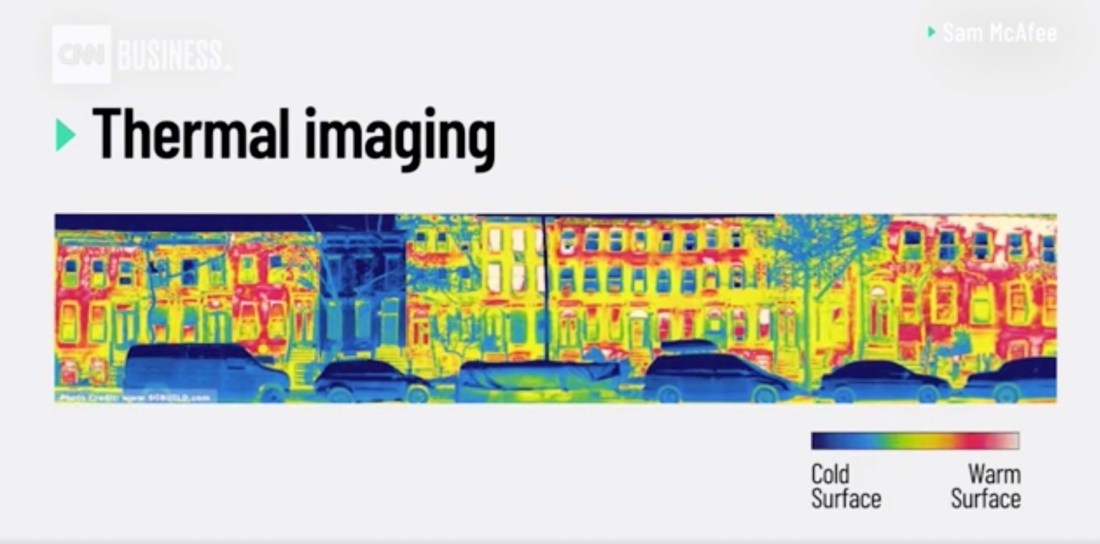
My friend Michael Ingui of Baxt Ingui Architects recently launched a one-stop-shop site for all things passive house called Passive House Accelerator (disclosure: I am an advisor). It is the place to go to find out anything you want to know about the concept, from the basics to details on specific implementation issues. To learn more, start with the “what is a passive house?” post or watch a 3-minute video that recently aired on CNN. On a simple level, it’s building a house that is much like a thermos that keeps your coffee hot or your beverage cold for many days, but with a built-in fresh air system so that occupants of a passive house breath clean, fresh, filtered air at all times. Passive houses are healthier for both people and the planet. A thermal image of a row of brownstones in the CNN video shows how passive houses don’t leak (and conventional houses leak like crazy). The passive house is the dark blue one that is fourth from the left:
Building costs are 2-4% more on a typical passive house than conventional building and decrease as a building scales because the mechanicals and heating/cooling systems go farther in such an environment. Of course, when you are reducing energy usage ~80%, the slight premium on building gets paid back pretty quickly with substantially reduced operating costs. With modest solar installations, many passive houses can achieve net zero energy usage, or close to it.
Passive houses aren’t just for people and organizations with lots of money and resources. The positive long-term economics mean that passive house building is increasingly being used for affordable housing projects. In May, an affordable housing development for seniors in Corona, Queens was unveiled that was built to passive house standards. The Rural Studio at Auburn University’s College of Architecture, Design and Construction has an exciting 20K Initiative where they are experimenting with passive house design to provide affordable homes in rural Alabama, recognizing that the initial cost of a home is only the beginning of the equation when it comes to affordability. Operating the home is key, and lowering energy usage is the clearest path to ongoing affordability. Sustainability and affordability go hand-in-hand (read this in-depth Dwell piece for more info on this program).
I have never been more excited about anything as I am about passive house building. It’s rare that you see something that successfully combines human comfort and massive gains in energy efficiency. If you’re building a home or involved in a building project anywhere in the world, make sure you ask your architect and general contractor about passive house (and point them to Passive House Accelerator to learn more). This is not science fiction or a “wave of the future.” We don’t need new investments in research for this to work. It’s possible right now and happening all around us. Spread the word.
 Chad Dickerson's blog
You must be logged in to post a comment.