Was LBJ a racist?

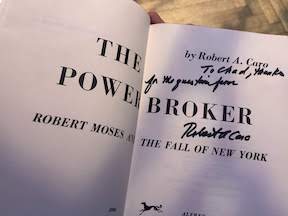
I recently bought tickets to see Robert Caro as part of BAM’s Eat, Drink, and Be Literary series in Brooklyn (if you live in Brooklyn or are visiting, it’s an awesome series). In one of those “what five living people would you have to dinner?” exercises, Caro would be on my list. His bios of Robert Moses (The Power Broker) and LBJ (The Years of Lyndon Johnson – four volumes with a final volume on the way) are absolutely incredible and worth the years it might take you to read them. I’ve read both and they are on my all-time top 10 list. Read them if you can.IMG_1790
In the Q&A section of his talk, I asked Caro a question about LBJ’s “true” self as it relates to his
views on race since he may know more about LBJ than any person alive. You can get some sense of it by reading the books but to be able to ask Caro directly was an incredible honor (and an even greater honor to have him sign my copy of The Power Broker and thank me for the question!) He gave such a rich answer that I’m posting it here with no commentary, only a few hyperlinks.

——

Me: Lyndon Johnson was a complex man. On the one hand, some would call him a racist, yet no President had more of an impact on civil rights and voting rights. I’m curious, how do you think about that juxtaposition?

Robert Caro: What you said is one of the most interesting things. For the first 20 years he was in Congress and the Senate, he was 100 percent against civil rights. He voted against every single civil rights bill, even against bills that would have made lynching a crime. He voted against everything.

It wasn’t just his votes. He was a Southern strategist. He was actually the protégé of the Senator Richard Brevard Russell of Georgia, who was the leader of the Southern bloc for 20 years. It was Russell who raised him to power in the Senate. Because Russell believed — Lyndon Johnson made him believe — that he, Lyndon Johnson, hated black people as much as Richard Russell did. It’s then, he said, “This is the same man,” who in 1957 passes the first Civil Rights Act.

Well, the Southerners are still such in power in Congress. Then when he becomes president there for Kennedy’s assassination, there’s this wonderful scene. He has to make a speech to Congress three days after the assassination to a joint session of Congress. He comes down, and he’s still not in the Oval Office of the White House. He’s living in his home in Spring Valley in Washington. His speechwriters — four speechwriters — are downstairs writing his speech. Around midnight, Lyndon Johnson comes down in his bathrobe. and he says, “How are you doing?” They said, “The only thing we’re agreeing on is you must make a priority of civil rights. Try not to mention civil rights, because if you do that, the Southerners are going to do the same thing to you that they did to Kennedy.” “They’re going to stop everything if you try to pass civil rights.” They said, “It’s a noble cause, but it’s a lost cause. Don’t bring it up.” Johnson says, “Well, what the hell’s the presidency for, then?” [I wrote about this on my blog a while back]

In his speech, he says, “The first priority is to pass John Kennedy’s civil rights bill.” [YouTube video – see segment starting at 15:20] To watch him do that, as I said before, I’m not sure we would have it today if he hadn’t been the president then. You say, “Did this man really believe this, or was it politically just expedient?” The reason I feel like no — that he always believed it — is when he was in college, he was very poor. Including his sophomore and junior years, he had to drop out of college and teach elementary school for a year to get enough money to go on. He teaches in this largely Mexican town near the border called Cotulla in Texas. The kids are, after listening and reading the oral histories more than the time he grew up — there are not too many alive. After reading what these children had said later, I wrote, “No teacher had ever cared if these kids learned or not. This teacher cared.”

I feel Lyndon Johnson always wanted to do this. He was writing this great speech, which we all know, the “we shall overcome” speech [YouTube video]. It’s not “them” who must overcome, it’s “we” who must overcome prejudice, and “we” shall overcome. That’s the speechwriter Richard Goodwin, who I asked something like, “How do you know he meant it?” Goodwin said that he wasn’t sure that Johnson did, until Johnson called him and said, “You know, I told you about teaching those kids in Cotulla.” He said, “Well, I’ll tell you something. I swore to myself then that if I ever got power to help them, I would help them. Now, I have the power, and I mean to use it.” I feel like Lyndon Johnson intended to do this all his life when he got power.

Can charisma be learned? (Yes.)

One of the recent lectures I put together for the BigCo Studio class at Cornell Tech was about pitching an idea and winning support for it inside the specific context of big companies. Anyone who wants to see Airbnb’s original pitch deck can find it easily on the Internet but the heroics of Sally — the Director of Division X inside of Acme Corporation — pitching and winning organizational support for a new initiative are lost to the annals of that company’s water-cooler history, never to be heard from outside the walls of the BigCo. In our class, we are trying to surface what we’ve learned about success in BigCos since those BigCo experiences are not shared in the same way as the legends of the startup world.

One of the hardest parts about teaching if you’ve been doing the actual work for a while is clearly articulating concepts and approaches that may have become intuitive for you from experience but are entirely new to those whom you are teaching. In this spirit, one of my early drafts of my lecture about pitching an idea and winning support for it had a slide with this simple phrase: Being charming helps. I believe this to be true but I was having a hard time articulating it in an actionable way, which is the essence of teaching. Without being actionable, that phrase is just a useless aphorism. I didn’t want to take it out, though, since I think it’s so important. This quandary forced me to think harder and dig deeper on the topic: can you learn to be charming? I found some research in an HBR piece, “Learning Charisma.”

In this piece, the authors identify a dozen “CLTs” (charismatic leadership tactics), nine of which are verbal and three of which are non-verbal. The verbal CLTs are:  1) metaphors, similes, and analogies, 2) stories and anecdotes, 3) contrasts, 4) rhetorical questions, 5) 3-part lists, 6) expressions of moral conviction, 7) reflections of the group’s sentiments, 8) setting of high goals, and 9) conveying confidence that high goals can be achieved. The  non-verbal ones are 1) animated voice, 2) facial expressions, and 3) gestures. You should read the article to see more context on the list.

What does using these CLTs do? In short, their research shows that training people to be charismatic via use of them delivers results. Here’s the data:

  • When a group of midlevel European executives doubled their use of CLTs in presentations, observers’ numerical ratings of their competence as leaders jump by about 60% on average.
  • About 65% of people who have been trained in the CLTs receive above-average ratings as leaders, in contrast with only 35% of those who have not been trained

This was a little surprising to me and I’ll admit that I had a visceral negative reaction to the list as I thought about leaders being trained to do things like display “expressions of moral conviction.” But the more I thought about it, the more I thought that the list is pretty useful and rings true. The researchers don’t say that one should be delivering fake “expressions of moral conviction.” Viewed in a positive light, the list of CLTs is simply a structured way to encourage leaders to connect with and articulate their true sense of purpose, tell stories that people can understand, relate to how people are feeling, articulate high goals, and inspire teams to meet those goals.

So, if you thought charisma couldn’t be taught (as I did), think again. Sometimes when you have the opportunity to teach, you end up learning something yourself.


p.s. John Kotter at HBS has done a lot of interesting work on gaining buy-in for ideas inside BigCos, so I talked a lot about his work in my lecture, including his awesome book Buy-In: Saving Your Good Idea from Getting Shot Down which he talks about in this interview. Key quote:

Whether it’s a little deal with half a dozen players or a big decision at a company with hundreds or thousands of people, you’re in the murky land of human nature and group dynamics. And look at the curriculum in business schools — compare the amount of time that’s spent coming up with the idea that solves the problem with the amount of time spent thinking about how we can take this idea and communicate it, get enough people to understand it, support it, and then go on and make it happen. . . I think the ratio in most MBA programs is easily 80/20.

He’s right based on my experience inside companies. Our class is multidisciplinary and includes MBAs. In my lecture, I followed Kotter’s lead and flipped the ratio to 80/20 in favor of talking about human nature and human dynamics. Kotter’s book includes a list of four specific strategies people use to shoot ideas down in complex organizations along with twenty-four specific and commonly-used questions / comments / arguments used in those situations. It’s an excellent list and worthy of carrying on a laminated card in one’s wallet or purse. Two examples from the twenty-four are “Tried that before — didn’t work” and “You have a chicken and egg problem” but my absolute favorite (and one I’ve heard many times) is “What about THIS?” — “THIS” being a worrisome thing that the proposers know nothing about and the attackers keep secret until just the right moment].”