 I lived in Berkeley, California from 1998-2008 and the state made an indelible impression on me that leaves me feeling deeply connected. The many tragedies out there this week have had me thinking about how much California means to me and how much I’m hoping for the best for everyone out there on the west coast.
The people, the landscape, and the culture of California changed me in ways that are hard to articulate. On a fundamental level, living in California transformed me into a person who thought bigger, dreamed bigger, loved bigger. California opened me up in a million different ways and I will always love it deeply for that. It feels like a home to me, one of the handful of places where I feel in sync with life in a deeply fundamental way.
The landscape there is nearly beyond description. It is absolutely awe-inspiring and I never got used to it. I read Dave Eggers’ A Heartbreaking Work of Staggering Genius when it came out just after I moved to California and it captured my excitement better than I ever could:
We run back across the highway, back into the red Civic and keep driving. Past the surfers, through the eucalyptus forest before Half Moon Bay, birds swooping up and over then back, circling around us—they too, for us!—then the cliffs before Seaside—then flat for a little while, then a few more bends and can you see this motherfucking sky? I mean, have you fucking been to California?
Oh, yes, I have fucking been to California. And it really is grand. A glorious mess in so many ways — just like some of the people I love most — but just stupendous. I’ll leave it to other people to lay out their critiques but I’m thinking of California with love and the feeling of wonder that never waned, wishing the best for everyone out there during a difficult time. I love you, California.
p.s. couldn’t resist including another passage from Eggers’ book, describing the magic of many places I know and love from my time in Berkeley:
To our right is the Pacific, and because we are hundreds of feet above the ocean, often with nothing in the way of a guardrail between us and it, there is sky not only above us but below us, too. Toph does not like the cliff, is not looking down, but we are driving in the sky, with clouds whipping over the road, the sun flickering through, the sky and ocean below. Only up here does the earth look round, only up here does the horizon dip at its ends, only up here can you see the bend of the planet at the edges of your peripheries. Only here are you almost sure that you are careening on top of a big shiny globe, blurrily spinning—you are never aware of these things in Chicago, it being so flat, so straight—and and and we have been chosen, you see, chosen, and have been given this, it being owed to us, earned by us, all of this—the sky is blue for us, the sun makes passing cars twinkle like toys for us, the ocean undulates and churns for us, murmurs and coos to us. We are owed, see, this is ours, see. We are in California, living in Berkeley, and the sky out here is bigger than anything we’ve ever seen—it goes on forever, is visible from every other hilltop—hilltops!—every turn on the roads of Berkeley, of San Francisco— We have a house, a sublet for the summer, that overlooks the world, up in the Berkeley hills; it’s owned by people, Scandinavians, Beth says, who must have some money, because it’s all the way up there, and it’s all windows and light and decks, and up there we see everything, Oakland to the left, El Cerrito and Richmond to the right, Marin forward, over the Bay, Berkeley below, all red rooftops and trees of cauliflower and columbine, shaped like rockets and explosions, all those people below us, with humbler views; we see the Bay Bridge, clunkety, the Richmond Bridge, straight, low, the Golden Gate, red toothpicks and string, the blue between, the blue above, the gleaming white Land of the Lost/Superman’s North Pole Getaway magic crystals that are San Francisco . . . and at night the whole fucking area is a thousand airstrips, Alcatraz blinking, the flood of halogen down the Bay Bridge, oozing to and fro, a string of Christmas lights being pulled slowly, steadily, and of course the blimps—so many blimps this summer—and stars, not too many visible, with the cities and all, but still some, a hundred maybe, enough, how many do you need, after all? From our windows, from our deck it’s a lobotomizing view, which negates the need for movement or thought—it is all there, it can all be kept track of without a turn of the head. The mornings are filmstrip white and we eat breakfast on the deck, and later we eat lunch there, we eat dinner there, we read there, play cards, always with the whole thing, the postcard tableau, just there, all those little people, too much view to seem real, but then again, then again, nothing really is all that real anymore, we must remember, of course, of course. (Or is it just the opposite? Is everything more real? Aha.) Behind our house, not too far, is Tilden Park, an endless expanse of lakes and trees and hills, mohair hills touched by patches of shrubs—as in, mohair hill, mohair hill, mohair hill, then an armpit of dark green, then the mohair hills that go on and on, like sleeping lions, as far as— Especially when you’re on your bike, starting from Inspiration Point (No. Yes.), pedaling into the wind on your way in and with the wind on the way back, the hills going on until Richmond, miles away, where the factories and power plants and big tanks full of deadly or life-giving things are, and the bike path goes the whole way there, all the while with the Bay visible in the distance to the left, the hills on and on to the right, until Mount Diablo, the biggest of all of them, king of the mohair hills, twenty miles east, northeast, whatever. The paths are paralleled with and perpendiculared by wood and wire fences that hold cows, and sometimes sheep, and all this is minutes away, all there, from our house, our house behind which there’s even a hiking trail that reaches, just about reaches, the huge rock, Grotto Rock, that juts out twenty feet beyond our back deck, and on some days, when Toph and I are eating our breakfast out on the porch, with the sun crazy and happy for us, smiling and teary-eyed with pride, there will suddenly appear hikers, male and female, always coupled, in their khaki shorts and brown shoes and hats on backward, who will step up from below the rock, and then be atop it, and then be there, holding their backpack straps with their thumbs, at eye level with us, as we eat our breakfast on our redwood deck, twenty feet away. “Hello!” we say, Toph and I, with compact waves. “Hello,” they say, surprised to see us there, eating our breakfast, at eye level. It is nice, this moment. Then it’s awkward, because they are at the the top, the end, of their hike, and want only to sit down for a while and admire the view, but can’t help be conscious of these two people, impossibly handsome people, Toph and I, who are sitting not twenty feet behind them, eating Apple Jacks from the box.

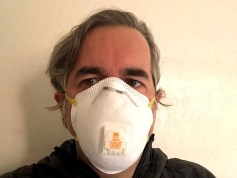 For the first day or two, I didn’t worry too much about breathing the air. I wasn’t in one of the “sensitive groups” that were advised against breathing it. But as the air quality worsened, I started dragging. Headache, dry mouth, voice growing raspy. I got my hands on an N95 mask and it has become my steady companion. It is an anxiety-ridden companionship. I’ve gone from my usual this-too-shall-pass optimism to an unsteady when-will-we-be-able-to-breathe-like-we-used-to worry.
 Chad Dickerson's blog
You must be logged in to post a comment.